
Graham’s Great Adventures
Jordan & Egypt2026
From the Dead Sea to the Pyramids of Giza | Graham Broyd
Contents
Setting Off · Arrival & Dead Sea · Bethany · Dead Sea Swim · Jerash · Mount Nebo · Madaba · Petra · Petra — Personal · Wadi Rum · Leaving Jordan · Abu Simbel · Philae · The Nile · Kom Ombo · The Rowboat Salesmen · Luxor Temples · Valley of the Kings · Grand Egyptian Museum · Cairo to Giza · The Great Pyramids · Khan El-Khalili Bazaar · Al-Rifa’i Mosque · Abu Serga · National Museum · Last Post
Jordan
Setting Off — January 3, 2026
1 photo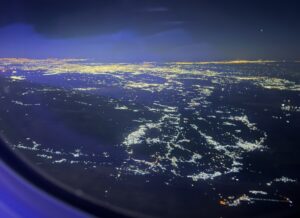
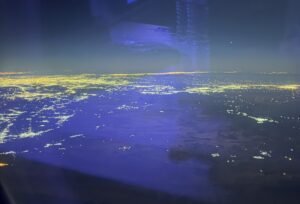
Jordan and Egypt. It’s 2026, so it’s time to travel. Tomorrow we head off to Doha on the way to Amman, Jordan and Egypt. The trip includes Mount Nebo, (where Moses first saw the Promised Land), Petra, the Aswan Dam, a trip up the Nile, the Great Pyramids of Giza, the newly opened Grand Egyptian Museum, and Cairo. I know very little about Egypt and Jordan, but expect it to be other-worldly. I hope to finish the 600 pages of The Rise and Fall of Ancient Egypt before we land.
We have a photo of my father, who was stationed in Egypt at the end of WW2, leaning against the Sphynx. Unfortunately my brother and I can’t locate the photo, otherwise I would ask the guards to just let me replicate the photo when we get there…….
I never thought I would be excited to be flying over Baghdad. But there it is….
Arrival — Amman and the Dead Sea — January 5, 2026
2 photos
We arrived in Amman, capital of Jordan and drove 60 miles west to the Dead Sea. We are staying at the Kempinsky Hotel.
Geographically, the first photo is worth a moment. We are at the mud beach on the coast of the Dead Sea. On the far side of the Sea, the greenish area is the West Bank of Israel-Palestine. The white buildings to the right far side are the City of Jericho, founded 10,000 years ago. On the top of mountains in the background — Jerusalem.
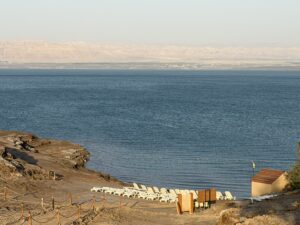
We are very close to the banks of the River Jordan that now separates Jordan and Israel. 20 minutes up the road is Bethany, where John baptized Jesus. Another 30 minutes along that road is Bethlehem, (not the steel mill in Pennsylvania, but the place of birth of Jesus.)
More later….
Bethany, Beyond the Jordan — January 5, 2026
 7 photos
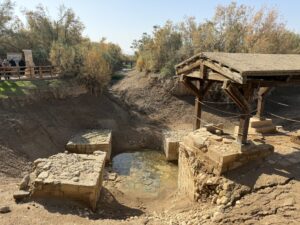
‘Bethany, beyond the Jordan’ where, (it is claimed), John the Baptist baptized Jesus in the River Jordan. (There is a place on the other side of the river with similar claims.) The exact location of the baptism being between the four stone pillars in the first two photos. John’s Cave, where he lived, in the third photo.
Tellingly, there were the remains of five churches here since 500 AD, with no people anywhere in the area to make up a congregation. There are Catholic, Coptic, Greek Orthodox, Armenian and one other church here today. Our tour group (non-Tauck), was made up of visitors from Yemen, Georgia, (the country), Bulgaria, Singapore, Germany, US, and Poland.
There were many people baptizing themselves (if there is such a thing), in white robes in the main part of the river. On the far side of the river, maybe 40 feet away, was Israel and their flag. On our side Jordan, and heavily armed guards.
It was only after a peace treaty with Israel in 1994 that Jordan removed all the land mines in the area and started to develop the historic site. This site also included Elijah’s Hill, where Elijah was taken up to heaven on his Chariot.
The Dead Sea — January 6, 2026
6 photos
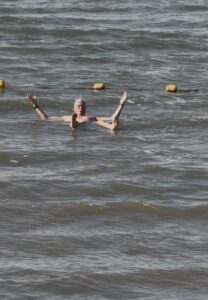
I went to swim in the Dead Sea. The buoyancy was remarkable, literally pushed your limbs out of the water. It was impossible to get your head under water. It’s 35% salt, and the minerals in the water include potassium, magnesium, calcium. Tastes horrible. The Dead Sea is the lowest place on earth, some 1500 feet below sea level, but drying out about 2 feet every year. Very high percentage of oxygen in the air (opposite of high altitude).
Screenshot
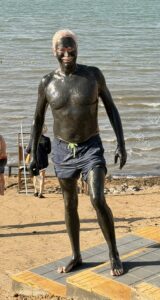
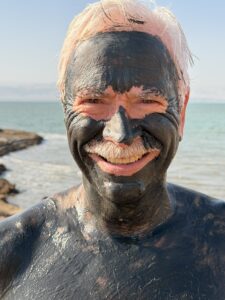
And then of course there was the mud massage. Which was wonderful. The whole combination was very exhilarating.
Jerash — January 6, 2026
North of the capital city of Amman. Damascus, Syria is just 2 hours away. The largest Roman excavation site outside of Rome. Jerash was on the main trade route from Petra to Damascus, and at the crossroads of the Silk Road going from China to the Mediterranean and the Incense Road going from Yemen to the north.
Jerash was effectively built as a Roman soldier retirement home. 30,000 retired troops. Just like today’s communities — a walled and gated community; a sports arena (for chariot races); a theatre for concerts, (Andrea Bocelli performed recently in these ruins); a main house, (the Theater of Zeus); multiple Churches; confirmed access to water via an aqueduct; and great weather.
Before this trip I admit that I had never heard of Jerash. Thats why we travel. It was stunning, better than Pompeii.
Interestingly, the excavated ruins cover about 1/3rd of Jerash. The rest if the area is a sophisticated, built up, commercial city. They all know that there will be significant discoveries under the town — but there are limited funds, or desire, to dig up a busy, successful city.
As with other areas visited so far — safe, clean, prosperous and friendly.
One additional note from our drive today. Jordan’s population has grown from 2.5 million to 11.5 million in the last 35 years, since 1990. It acts as a buffer state in the region, well managed, and retaining relations with all neighbors (except Iran), as a result it has taken in millions of refugees, as a regional safe-haven. 1.4 million from Syria 2 years ago. We drove through a suburb of Amman, populated primarily by Iraqis. The Iraqi wealthy and sophisticated left after the US invasion. All luxury buildings and residences. Land prices — previously occupied by bedouins/gypsies — now go for $1 million per 1/4 acre. Interesting.
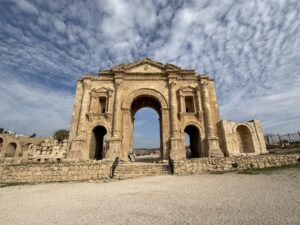
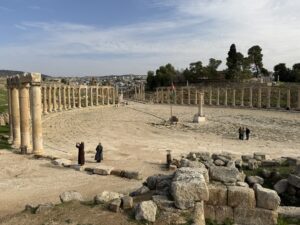
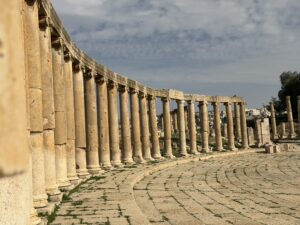
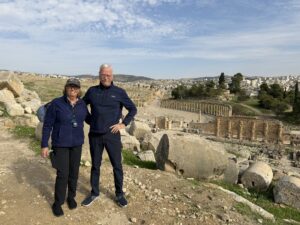
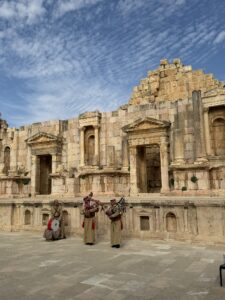 📷 The Roman ruins of Jerash — the theatre, the colonnade, the forum
Mount Nebo — January 7, 2026
19 photos
“Then Moses went up from the lowlands of Moab to Mount Nebo, to the town of Pisgah, east of Jericho and the Lord showed him the whole land…”
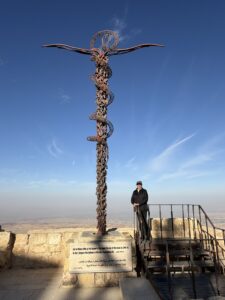
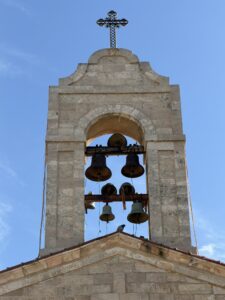
We went to the Moses Memorial site this morning. The Christian church was first built in the 400s. The stunning Byzantine murals were put down between 530 and 560 AD. The wonderful statue of the cross and the serpent — The Brazen Serpent Monument of Mount Nebo — was redesigned recently and the Catholic Church built over the murals reopened in 2016.
The Promised Land was a little hazy this morning, but just 16 miles west, over the Reft Valley (which looks a little like the Grand Canyon), the Dead Sea, the West Bank, Jericho, to the mountains where Jerusalem sits.
The sandstone statue is of the book of love, built for Pope John Paul II, who visited in 2000 and looking out across the valley said: “Yes. There it is.”
One photo showing the Bedouin, living in their tents in the valley, herding the sheep. The Bedouin, live in tents made of goats hair, own no land, are nomadic, subsist off what they can grow and feed in the sandstone — but carry smartphones and sometimes have Starlink to pick up streaming TV.
Madaba — January 7, 2026
18 photos
The Greek Orthodox Church of Madaba which contains the Madaba Mosaic Map. Made between 542 and 570 AD. The church was originally dedicated in 542. The Map depicts an area from Lebanon to the Nile Delta and from the Mediterranean to the Eastern Desert. So much of what has been excavated over the last century has proved this incredibly ancient map to be exactly correct. It does have John baptizing Jesus at the spot we went to in Bethany. It also has the Jordan River about a mile across as it exits the Dead Sea, whereas today it is not much more than a stream. It includes a lot of detail of the buildings in Jerusalem.
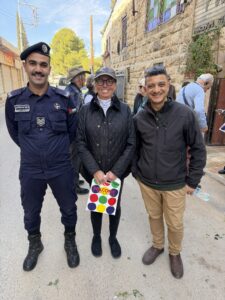
Betsy with Mohammed our guide and Ahmed our guard.
And we have now arrived in Petra — with great excitement.
Petra — One of the Seven Wonders of the World — January 8, 2026
25 photos
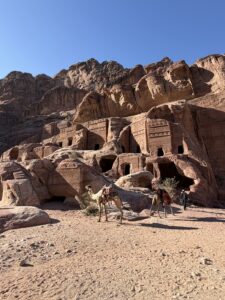
So much to write and explain. Our guide called it the ancient Dubai. The crossroads of the main trade routes, from 4,000 BC to about 1,000 AD.
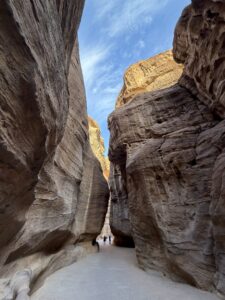
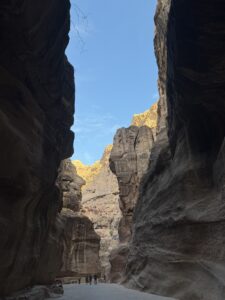
It is sandstone, a little like Bryce Canyon. Petra sits on the edge of tectonic plates between the Arabian Peninsula and the Levant. The tectonic shifts have created these incredible rock formations but also eroded a lot of the artifices and artifacts. And water has eroded a canyon down through Petra.
The Incense Route came from Yemen through Medina and Mecca to the north of the Red Sea, up to the Dead Sea, and through the Rift Valley to Damascus and Assyria. They brought frankincense and myrh. There is a photo — frankincense is the glass-like boulder, myrh the dark powder. They had to pass through Petra.
Populated by the Nabateans, who were bedouins but became organized and commercial, until the Romans moved in about 140AD. It was one of the richest cities in the world from 1000BC to 1000AD. Then the trade route from the Arabian Peninsular to the Mediterranean was established east-west across the Red Sea and diminished the importance of Petra’s location.
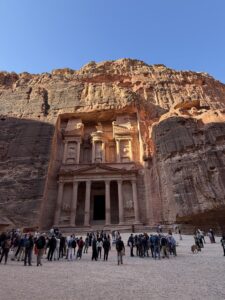
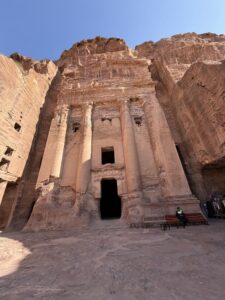
The monuments, unlike the pyramids and tombs in Egypt are all carved into the rocks. There is nothing inside. The most famous one is The Treasury. You walk down over a mile of a very narrow (15-40 feet wide) but very tall (150 to 350 feet) canyon and then it suddenly opens into a big square where you face the Treasury which is 120 feet tall.
They don’t know what it was — a tomb, a treasury, a palace — the general assumption is that it was just meant to be a ‘wow’ impactful site as you exit the canyon, to impact all visitors — be they ancient warriors or merchants or tourists. They succeeded.
I walked 6 miles through it today, there is a lot more. Indiana Jones and the Last Crusade was filmed here.
Personal shots later.
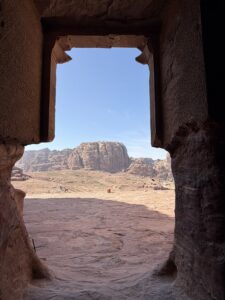
Petra — Personal Shots — January 9, 2026
11 photos
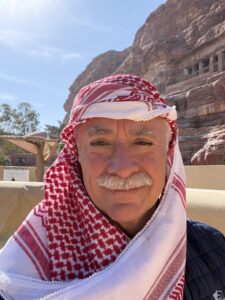
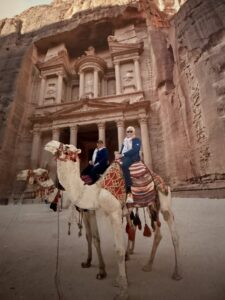
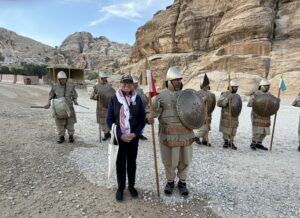
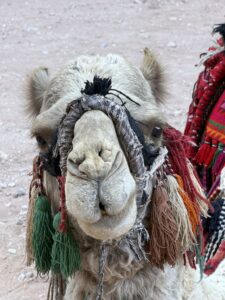
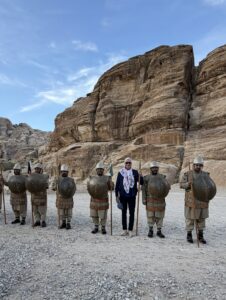
Some less historically relevant photos.
Wadi Rum — The Valley of the Moon — January 9, 2026
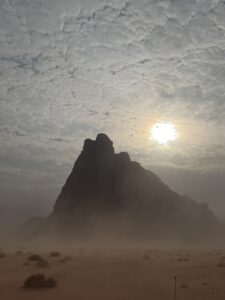
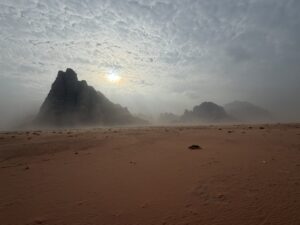
 15 photos
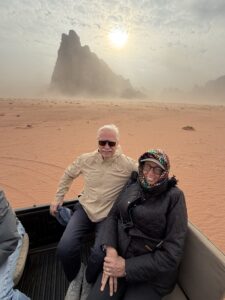
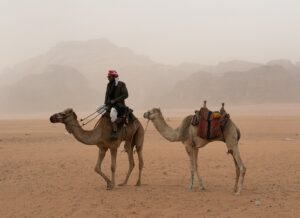
The Arabian Desert in southern Jordan. This is for Lawrence of Arabia. The desert he passed through as he brought the Arabs to Aqaba to defeat the Ottomans during WWI. Aqaba sits on top of the right finger on the top of the Red Sea. At the confluence of Jordan, Israel, Saudi Arabia and Egypt.
Lawrence went through the desert to surprise the Ottomans who were defending the Sea of Aqaba with cannons pointed towards the sea. It was the turning point of the defeat of the Ottoman Empire and the establishment of the rulers of King Saud.
The desert landscapes were remarkable. Other-worldly. Star Wars, Dune 1 and 2, The Martian, obviously Lawrence of Arabia, all filmed here.
The early photos are of Lawrence’s seven pillars of peace, how he described the mountain peaks. Bedouin country. I expected to see Omar Sharif ride over the horizon at any moment.
Lawrence was a British Officer who had learned Arabic at Cambridge, fell in love with the Bedouins and Arab culture and led them to change the regional history. We passed the train line where he attacked the train on horseback.
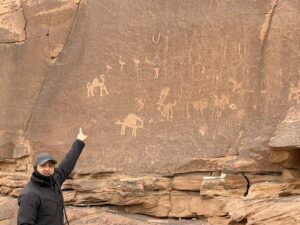
Hieroglyphics on the wall of camels and men with spears riding them and the only other animal living here — the Oryx.
Leaving Jordan — January 10, 2026
14 photos
We left Jordan today. A moment for a Broydism.
I wanted to see Egypt. And Petra. Jordan got added on as it was on the itinerary. What a magnificent and wonderful country. It is the only land route between Africa and Asia. A critical geopolitical and geographical country. But the most lasting impression I had was of comfort and safety.
On our trip we have been 20 feet from the West Bank of Israel and Palestine. Twenty minutes drive from the Syrian border. 100 miles from Damascus by road. Jordan borders Iraq to its east and Saudi Arabia to the southeast. Later today we will be close to the border with Sudan in Africa.
At no time did we fear for our safety. And not because we were surrounded by the military or armed guards. Everywhere we went was friendly, calm, clean, with reasonable infrastructure, even and wide roads, homes typical of lower middle incomes in the west.
Sure, we are on an organized travel itinerary, and Jordan will have areas of great poverty and increased levels of crime that we did not visit — but so do other countries. And we saw a lot of Jordan. At no time were we concerned about pick-pockets or purse snatchers, or of drunks wanting to pick a fight. The women drive, work, and are well-educated, wearing largely western dress adapted for the climate. As one local said: “What do you expect, my gandmother was a university professor in Jordan.”
In the US and the UK murder is most likely to happen between family or local community members (gangs), and you are most likely to be killed accidentally crossing the street in your local town. We are brought up to always think of home as the safest place, and by the media and our governments that our home country is the only safe place — it is dangerous and threatening and unsafe to go elsewhere. The further away, the more risk. Bad news is all we hear about from afar.
In Jordan, we saw the place Jesus was baptized; we swam in the Dead Sea; could see the Promised Land from Moses’ Mount Nebo; saw the ancient Roman city of Jerash; the ancient wonders and monuments of Petra; and Lawrence of Arabia’s and Star War’s deserts in Wadi Rum.
But most of all we learned, again, that travel is eye-opening, perspective-changing — and much, much safer than you ever imagine back home.
(And tomorrow I will probably get kidnapped in Egypt.)
Egypt
Good. Cursor to the end, paste Chunk 3:
Abu Simbel — January 11, 2026
21 photos
We are now in Egypt. Our arrival in Aswan delayed by a sandstorm, in true local tradition. We flew further south from Aswan to Abu Simbel, home of the Great Rameses statues.
Abu Simbel is 40 miles from the Sudanese border. And former capitol of Nubia, the rulers of Upper Egypt in the Old Kingdom. Rameses went through an extensive building campaign throughout Egypt to try and prove that he was both King and God. These were his most famous monuments. The statues of him and his Queen Neferari are 120 feet high, and the hieroglyphics inside are some of the more famous in Egypt.
More amazing than the original construction of the statues around the 13th century BC, is the fact that the whole complex was cut down and moved 60 years ago. The building of the Upper Aswan Dam was going to flood the whole area. Egypt reached out to UNESCO for help in preservation. Between 1964 and 1968, with the participation of 50 countries, they moved the whole complex, block by block, to a new site on higher ground and away from what would be Lake Nassar. Literally cutting the face off Rameses and transporting him on special built moving machinery to the new resting place.
The Temples of Philae — January 11, 2026
18 photos
We visited the Temples of Philae. Built in honor of the original ancient Egyptian God ‘Isis.’ (Nothing to do with the Islamic State of Iraq and Syria). Original buildings date to 3000 BC.
The monuments were also moved in the 1970s to a higher, granite island by the Egyptians, British, French and Germans. 47,000 pieces. Photo #5. On the wall the writings are the other Rosetta Stone. Hieroglyphics and Greek together so they could be translated.
Cats are considered royalty here and are everywhere. We are close to Sudan/Nubia, so wonderful local colors and of course I had to have a hat.
The River Nile — January 12, 2026
19 photos
It flows north towards the Cairo delta and the Mediterranean. Fed from its two main tributaries the White Nile from Lake Victoria and the Blue Nile in Ethiopia. Joining in the Sudan. 6,600km long, the longest river in the world.
It is the lifeblood of the Sudan and Egypt. Providing the prescious resource of water and silt to fertilize the land. Aside from the Mediterranean coast to the north and the coast to the Red Sea, the rest of Egypt is desert. The Western Desert towards Libya and the Sinai Desert on the east. On the West Bank of the river it is fertile — palms, mango trees and bulrushes. On the east of the river it is mostly sand and dust. The monuments are generally on the west side.
It has been dammed twice, the High and Low Aswan Dams. The first in 1902, largely British built, to provide better water retention, less dependent on the flood and drought seasons; the second in 1970, that time for water and electricity. It was the largest dam in the world and created the largest manmade water body in the world — Lake Nasser. It has had a negative impact on the natural generation of silt, the natural fertilizer for the farming sector.
Floating along, one does feel as if you are passing through time.
Kom Ombo Temple — January 12, 2026
12 photos
Remarkable, not for its structure or architecture but for its stories. Built to honor two gods, equally. Horus the Falcon God and Sobek, the Crocodile God. There are a lot of crocodiles here. They kept eating the locals and their livestock. They gave up trying to fight them and decided to deify them. Maybe that would work… There is a Crocodile museum here.
The first Egyptian calendar. Dating back to around 2773 BC. We see part of it here, not in a museum, but on the wall of a temple we walked to, outdoors, on the banks of the Nile. On the photo #8 the first number is two ‘ones’ and two ‘tens’ symbolized by horseshoes. It counts down from 22 to 28, then symbols for weeks, months and seasons. 24 units in a day. 10 days in a week, ended up being with 2 days of rest. 3 weeks in a month. 4 months in a season. 3 seasons. Seasons from the Nile. High water or flooding; low water or drought; and Harvest. 5 days eventually added by the Romans for celebration.
Then Medicine. Imhotep. Early and powerful #2 to King Djoser of ancient Egypt, about 2650 BC. Founder of Egyptian Medicine. Imhotep is shown in the photo, but missing the block with his head. To his left in hieroglyphics are medical recipes, used then and many still in use today. And medical instruments, again most of what you find in an operating theaters today.
Very advanced for almost 5,000 years ago, primarily due to their mummification process. They were used to extracting the organs from the body before mummifying them. Heart and brain, even the appendix. As a result complex surgeries on living Egyptians were performed 3,000 years ago.
Our Egyptologist guide is wonderful. A Coptic Christian from Luxor/Thebes.
The World’s Worst New Business Initiative — January 12, 2026
2 photos
Two Egyptians in a row boat trying to sell table cloths to a four deck high boat motoring towards the locks. When they arrived at the front of our boat the price was $20, by the time they were about to disappear off the back of the boat, as we sped by, they were down to $6. I am not sure how they expected to receive payment, were we meant to throw dollars off the top deck of the ship? But an A for effort.
The Luxor Temples at Night — January 12, 2026
23 photos
Luxor was previously Thebes and the capital of Egypt. Different developments here at different times from 3000 BC to 100 AD and later. Pharaos, Greeks, Romans and even Napoleon’s troops who stationed here.
Ramesses II was prominent again. That is him all across the front. Still trying to prove he was both God and King. I noticed that he is missing his bight right toe on the left entrance statue — very empathetic.
The matching right hand entrance Obelisk, that is missing, is at on display outside the Place de la Concorde in Paris, France. The sitting couple in photo 12 is King Tut and his 9 year-old, half-sister wife. The penultimate photo is of Alexander the Great, who conquered Egypt in 320 BC, a rarity to find him engraved on an Egyptian temple.
And the last photo’s story probably would not pass the Facebook police, (but it does derive the phrase ‘losing an arm and a leg.’)
Pretty special under the lights at night. There are thousands of people there during the day.
Valley of the Kings — January 13, 2026
23 photos
24 Kings/Pharoahs are buried here in the Necropolis. All were burglarized and the jewelry and ornaments taken away. Except one. For a King, who died at 19, of a broken leg. So inconsequential that another King built his tomb on top of his. Which meant they had not discovered it until the last day of British archeologist Howard Carter’s 5 year excavation in 1917. And they found the lost coffin, untouched, in perfect condition.
King Tutankhamen. The mummy is still here — he was not looking so good. Everything else (5,000 pieces) has gone to the Grand Egyptian Museum in Cairo, (where we will be tomorrow). We had our own private late afternoon visit, usually thousands would be here. We also went in Ramesses III and Ramesses IV’s more elaborate tombs. The colored Hieroglyphics and stories were fantastic.
Good. Cursor to the end, paste Chunk 4:
The Grand Egyptian Museum — January 14, 2026
21 photos + 2 singles
The full museum only opened in November. It’s a magnificent and unique architecture. Designed by an Irish and Chinese couple. One whole wing is dedicated to the over 5,000 treasures from King Tut’s tomb, the tomb in the Valley of the Kings that we were in yesterday.
What is so remarkable about the treasures are that King Tut was a forgettable and unremarkable King. Ruled from the age of 9 to 19. Never won a war or major battle, no significant accomplishments, married his 14-year old half sister, no heirs, had a club-foot, died from a broken leg or cracking his head open when he fell, but because his tomb was underneath another tomb, it had not been found and burglarized. The extent of treasure found is beyond one’s imagination. Just a few photos here.
We can only imagine what would have been in Ramesses the Great’s tomb. Ruled for 66 years, lived until 90, won major wars, transformed the Egyptian Empire, built massive statues in his honor in all corners of the Empire, and was considered a God as well as a King. His tomb was massive, but effectively nothing left in it by the time archeologists got to it. Probably could have filled the Met, the Louvre and the British Museum. We will never know.
Oh, and there is a dog in the Museum. A stray dog, that found its way in, got adopted by the staff, now vaccinated and tagged, and looks very healthy. Wonders around and greets people….Egypt.
Cairo Airport to Giza — January 15, 2026
30 photos
I return to a theme. We drove in from the Cairo airport that is to the east of Cairo, across the city of 22 million people to Giza, city of the Pyramids, on the west of Cairo. About an hour of driving.
Traffic moved smoothly. Roads were 3 and 4 lanes each way. No construction. No litter or trash. No noticeable potholes. No graffiti. No signs of poverty.
In three days time we will drive in from JFK in New York….
And when we arrived, the view from our restaurant at night and our balcony in the morning.
The Great Pyramids of Giza — January 15, 2026
5 photos
Our second of the Seven Wonders of the World on this trip. For me this was always the ultimate destination. My father served here at the end of WWII and we have photos of him standing against the Sphinx. It did not disappoint.
Built around 2600 BC. Over 2 million individual boulders, each between 1.5 and 10 tons in weight, granite, brought by boats from Aswan in the flood season — the old tributaries from the Nile went to the entrance way to the Pyramids. 140 meters high. (Almost 500 feet). Put in place by 100,000 workers, working 8 days out of 10, for over 20 years. Not slaves but organized workers who believed they were building for their God. They once went on strike over living conditions and the King came and apologized to them. Workers lived in estates in homes with bedrooms, living rooms, kitchens and even toilets, (not to be repeated in a house until the early 1900s). They were fed on bread, raw vegetables, meats and beer.
The 4 sides of these gigantic structures are all within 2 inches of identical width and the pyramid is pointed within less than one degree of due north. The granite was originally covered in limestone, with only a little remaining on one of the pyramids. They have sustained multiple earthquakes and thousands of years of weather erosion. An engineering project from almost 5,000 years ago. Truly mind boggling.
The Khan El-Khalili Bazaar — January 16, 2026
12 photos
Small and calm compared to Istanbul. Friday mid-day prayers started while we were in the market. Everything you never needed. And surrounded by beautiful mosques.
Al-Rifa’i Mosque — January 17, 2026
12 photos
Built in the 1860s. To our surprise it houses the tomb of the Shah of Iran. Mohammed Reza Shah Pahlavi. The pale green alabaster. Kind of topical. He was married to King Farouk’s daughter, and when exiled, Anwar Sadat reached out to the family so he could be brought ‘home.’
King Farouk was the last King of Egypt, the end of the monarchy that went back almost 5,000 years. General Nasser took power in 1952 in a military coupe. His tomb is the white one with the crescent, the 3 stars, snd the crown.
The mosque had wonderful Islamic design on the walls and massive high ceilings. Still in active use. The circle of lights are photos I took lying on the carpet floors, looking up, (as one does.)
Abu Serga — The Holy Family in Egypt — January 18, 2026
11 photos
I am not a biblical scholar, but I find the history interesting. Joseph, Mary and Jesus escaped Herod and the Romans and left Bethlehem and went to Egypt for three and a half years. This is a map of where they went. We visited where they stayed for over three months in Cairo, in a cavern that is now part of a Coptic Christian Church. Egypt was a Christian nation from then until about 650 AD when the Arabs turned them to Islam.
It has been said that Ramesses II was the Pharaoh-King during the Exodus. We have been told that is not possible as after Moses parted the Red Sea, it let him pass through, but the chasing Pharaoh and his army all drowned. Ramesses II died of old age at 91. Merneptah, a son of Ramesses, never a King, was discovered to have died by drowning when his mummy was found… His mummified body was white due to the high salt content.
The Egyptians are great at saying: “We don’t know, as it was a long time ago, but this is the evidence we have…”
National Museum of Egyptian Civilization — January 18, 2026
22 photos
Egyptian civilization from 35,000 BC (recent human discoveries), to present day. This is where the Mummies of 22 Pharaohs are displayed, they were paraded through Cairo when they arrived. No photos allowed. Truly remarkable. All tarred and black, only head, feet and hands showing, but distinguishable by their faces. Ramesses the Great still had hair. The Queen Nodjmet from around 1000 BC still had braids.
As our last stop on this tour, it brought all the history that we have seen and learned together.
A Timeline of Egyptian History
3000 BC — Narmer unifies Egypt and becomes the first Pharaoh King. The Ancient Egyptian era lasts until 300 BC. Two thousand seven hundred years. Highlighted by Ramesses the Great in the 1200s BC.
300 BC — Alexander the Great conquers Egypt for the Greeks. But Alexander loves Egypt and the Egyptians loved Alexander, so the Kings continued.
30 BC — Despite the best alluring efforts of Cleopatra with both Julius Caesar and Mark Antony, the Romans take control.
300 AD — The Byzantines take over, still a Coptic Christian country.
650 AD — The Rashidun Caliphate brings Arab control to Egypt, which has remained, in many different disguises to today.
1952 — The last ruling King, Farouk, is replaced by General Nasser. The military has dominated government affairs until today, with a brief interruption by the Muslim Brotherhood after the Arab Spring.
Somewhat simplified, I dont think I will ever teach Egyptian history, but the timeline helped me.
Last Post — January 19, 2026
80 photos — the Facebook maximum
What a trip. A shout-out to our travel company Tauck, especially our Tour Director Rachel. The itinerary, the logistics, the attention to detail, the special events, and especially the guides — Mohammed in Jordan, Magdi in Aswan and Luxor, and Manal in Cairo who were able to explain, and educate, and entertain.
It was a magnificent trip. Every single day was special.
The history is tough to wrap your head around. The sophistication in politics, warfare, engineering, construction, medicine, culture and arts that was happening 3000 BC to 300 AD in Egypt is mindboggling. There are so many lessons for us from their history. And Egypt and Jordan today were friendly, bustling, safe, and welcoming — and tourism is critical to their economies.
I enjoy sharing the experiences and the new places I see. For those who have enjoyed following along, thank you, and I remind all that my first book of travel stories was published last year — ‘Backpack, Jacket, Surfboard: My Journey across America — Then and Now.’ Available on Amazon.
I intended to add my ten favorite photos from the trip. But so many incredible sites and scenes I added the Facebook maximum. 80. Enjoy.
Back to Travel | Broyd Partners